Why higher rates, a record 2021 buyout vintage and a shrinking second lien market are pushing private credit returns to the two ends of the capital structure

EXECUTIVE SUMMARY
Fundamentally sound businesses, constrained by balance sheets sized for near-zero base rates.
Private credit has grown from a US$80 billion niche into a US$1.3 trillion U.S. market.(1) The growth story is well known. What is less appreciated is how much the market has changed inside that growth.
Three forces have reshaped where value sits in a leveraged capital structure: the rise of unitranche lending, a 530 basis point shift in base rates, and a record 2021 buyout vintage underwritten for a rate environment that no longer exists. Together they have hollowed out the cash-pay second lien market and created large, under-served demand for Structured Capital.
Penfund believes the next several years favour lenders who can move across the capital structure. Unitranche loans and Structured Capital (PIK notes and preferred equity) are today’s sweet spots. Prime Plus+ is Penfund’s response to a market that has become more complex and more dynamic. It has been designed specifically to invest in both, and to shift between them as the market moves again.
A Bigger Market, and a Different One
Banks left, private lenders filled the gap. Post-2008 capital rules pushed U.S. banks out of leveraged lending; their share of U.S. leveraged loan volume fell from more than 70% in the mid-1990s to roughly 25% by 2022.(1) Smaller middle market borrowers now have few alternatives to private credit, and larger borrowers increasingly prefer it: no ratings, no syndication delay, no “flex”, and known counterparties for the life of the loan.
But the product mix has shifted underneath the headline. Unitranche loans, a single facility blending senior and junior debt, grew from US$47 billion in 2019 to more than US$210 billion in 2024(1) and are now the dominant LBO financing structure. Every unitranche deal is a deal without a standalone second lien, and the addressable market for a narrowly focused subordinated debt fund has shrunk accordingly. Sponsors have also professionalized how they buy debt, and their capital markets teams favour partners with more than one answer.

The 2021 Vintage Comes Due
Near-zero rates produced a record year: U.S. buyout volume reached US$368 billion in 2021,(1) and those deals were generally struck at high leverage. The years that followed brought higher debt service costs, fading post-COVID demand and a closed IPO window. Exits stalled. By mid-2025 only an estimated 19% of 2021-vintage deals had been exited, against a historical norm of roughly 30%,(2) and more than 16,000 buyout-backed companies globally had been held for four or more years: 52% of the inventory, the highest share ever recorded.(2)
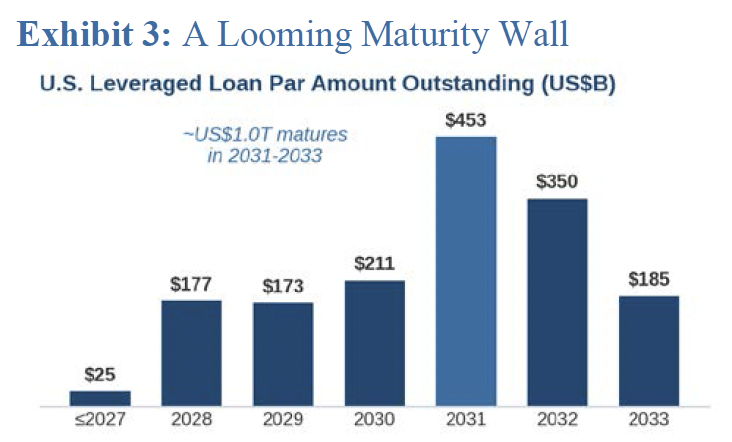
The result is a maturity wall built from companies that have not deleveraged as planned and whose sponsors have not yet created enough equity value to sell. Conventional refinancings are ill-suited to this cohort: many cannot carry more cash-pay debt at today’s rates.

Higher Rates Broke the Cash-Pay Junior Debt Model
From 2009 to early 2022 the Federal Funds rate sat below 1% for most of the period. From March 2022 the Federal Reserve delivered more than 530 basis points of increases, taking SOFR to roughly 5.3% by mid-2023.(3) For a borrower levered at 2021 multiples, that is a step-change in interest burden with no offsetting change in cash flow. Fixed charge coverage tells the story: average FCCR on new LBOs fell from 1.67x over 2015-2021 to 1.34x since 2022.(4) Borrowers responded the only way they could: the share of BDC portfolios carrying PIK features has risen from 7% in 2013 to 18% as of Q1 2026,(4) and U.S. second lien issuance collapsed from US$47 billion in 2021 to under US$1 billion in the first half of 2026.(1) Demand has migrated from cash-pay second lien and subordinated debt toward Structured Capital that does not require current cash servicing.

Returns Have Shifted to the Ends of the Capital Structure
For years second lien loans reliably earned 300-400 basis points over first lien. With base rates near zero that meant roughly 8.5-9.5% versus 5.5%, or 50-60% more return(6) for one step down the structure. Second lien was, genuinely, the sweet spot; Structured Capital earned only a marginal premium because there was little demand for it.


That has reversed. Base rates are far higher and second lien spreads have compressed, so second lien today offers modest incremental return over first lien and a minimal (in some years negative) premium to unitranche. Meanwhile the Structured Capital premium has widened: preferred equity earns 13-15% against 9-10% on cash-pay second lien at similar attachment points, and because bespoke instruments cannot be syndicated, fewer providers compete for them.
What Sponsors Need Now: Structured Capital
Many 2021-vintage businesses remain fundamentally sound; their capital structures are the problem. With sponsor equity contributions still at roughly 46-51% of purchase price,(1) a well-structured instrument attaches above a substantial common equity cushion. What these companies need is capital that does not add to cash interest, opens a refinancing path where conventional markets cannot, and lets the sponsor keep the upside.

The Opportunity in Front of Us
The convergence is unusual: a record vintage coming due, coverage ratios that cannot support more cash-pay debt, a second lien market that has all but stopped issuing, and a Structured Capital premium that has widened while the pool of providers remains narrow.
Reach out for a deeper dive into any of these topics, or to discuss how Prime Plus+ is positioning within middle market private credit.
Richard Bradlow, Partner
richard@penfund.com · 416.645.3794
Matthew Lee, Partner
mlee@penfund.com · 647.776.2165
Penfund Management Limited
Toronto, Ontario
This document has been prepared by Penfund Management Limited (“PML”) and its affiliates (collectively, “Penfund”) solely for informational purposes and is intended only for institutional and other sophisticated investors and their advisors. It does not constitute, or form part of, an offer to sell or a solicitation of an offer to purchase or subscribe for any securities, including limited partnership interests in Penfund Prime Plus+ Limited Partnership or Penfund Prime Plus+ U.S. Limited Partnership (together, “Prime Plus+” or the “Fund”), nor shall it form the basis of or be relied upon in connection with any contract or commitment whatsoever. Any such offer will be made only by means of the Fund’s Confidential Offering Memorandum and related subscription documents, which contain a description of the material terms and risks of an investment and which qualify the information contained herein in their entirety. Certain statements herein are forward-looking statements within the meaning of applicable securities laws, including statements regarding market conditions, trends, the Fund’s strategy, target returns and illustrative portfolio construction; they can be identified by terminology such as “may”, “will”, “expect”, “anticipate”, “target”, “estimate”, “intend” or “believe”. Such statements reflect Penfund’s current beliefs and are based on assumptions that may prove incorrect; actual events, results or performance may differ materially. Target returns and illustrative portfolio constructions are not forecasts, projections or guarantees of future performance. Past performance is not indicative of future results. Certain information has been obtained from third-party sources, including PitchBook LCD, KBRA DLD, McKinsey & Company, PwC, Bloomberg and the Federal Reserve; while believed reliable, Penfund has not independently verified it and makes no representation as to its accuracy or completeness. The case study is presented for illustrative purposes only and should not be considered a recommendation or representative of all Penfund investments. This document is confidential and may not be reproduced or redistributed without the prior written consent of PML.
Endnotes. (1) U.S. private credit AUM: PitchBook, May 2026 US Private Credit Monitor; bank vs. non-bank share, unitranche volume, U.S. LBO volume, leverage and equity contribution: PitchBook LCD. (2) Buyout inventory held four or more years: McKinsey Global Private Markets Report 2026, Clearer View, Tougher Terrain; share of 2021-vintage deals exited: PwC, as of mid-2025. (3) Base rate reflects LIBOR prior to January 1, 2022 and SOFR thereafter; Federal Funds rate from Federal Reserve Economic Data. (4) Market fixed charge coverage is calculated from market LBO leverage and institutional loan yields for targets with more than US$50 million of EBITDA, per PitchBook LCD; PIK share represents the top 15 publicly traded BDCs by fair value of holdings as of Q1 2026. (5) Maturity wall: PitchBook LCD, as of August 7, 2026. (6) First lien and incremental second lien spreads: PitchBook LCD; unitranche spread: KBRA DLD.